WITH A TOUCHING BIOGRAPHICAL NOTE BY MARY SHELLEY
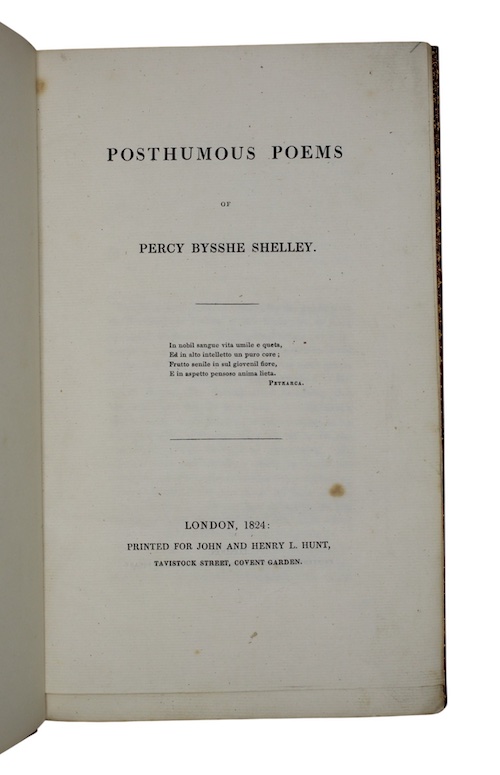
Posthumous poems.
London.
Printed for John and Henry L. Hunt, 1824.
First edition.
8vo.
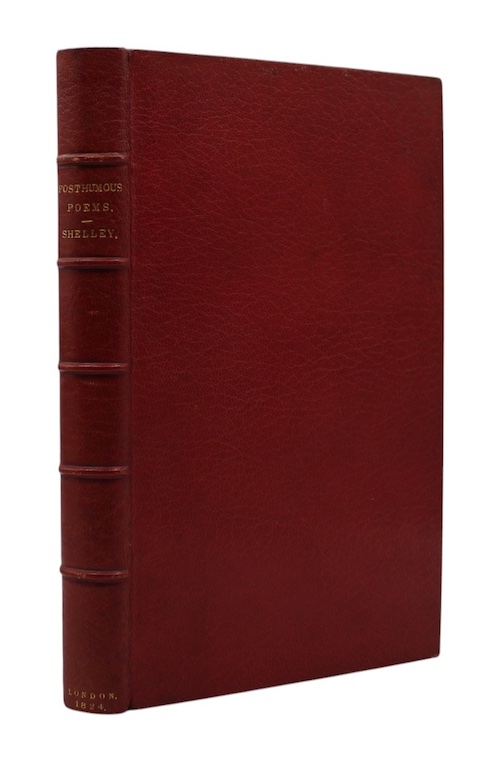
xi, [1], 415pp. [1]. Finely bound in nineteenth-century gilt-tooled red morocco, by Maclehose of Glasgow, marbled endpapers, T.E.G, others uncut. Extremities a trifle rubbed, slightly marked, corners a little bumped. Internally a little spotting to preliminaries, else a fine, generously margined unpressed copy.
'No man was ever more devoted than he, to the endeavour of making those around him happy; no man ever possessed friends more unfeignedly attached to him. The ungrateful world did not feel his loss, and the gap it made seemed to close as quickly over his memory as the murderous sea above his living frame. Hereafter men will lament that his transcendent powers of intellect were extinguished before they had bestowed on them their choicest treasures'.
A finely bound example of the first edition of a collection of Shelley's verse assembled by his widow - Mary Wollstonecraft Shelley - after his death in Italy, aged just 29, and lovingly prefaced by a biographical tribute which reveals much of the poet's nature, the context of the composition of many of his works, details of the couple's final years, whilst Shelley was plagued by 'ill health and continual pain', and the circumstances of his death and burial:
'Rome received his ashes; they are deposited beneath its weed-grown wall, and "the world's sole monument" is enriched by his remains'.
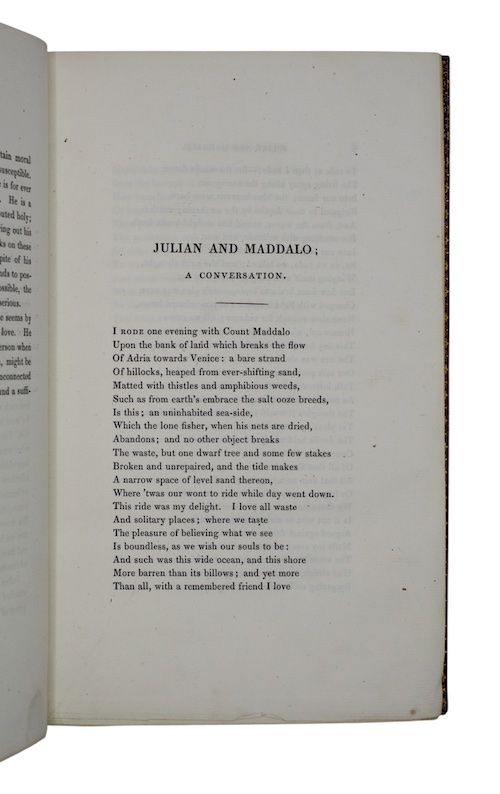
The contents includes unpublished work gleaned from 'among his manuscript books', such as 'Julian and Maddalo' and 'The Witch of Atlas', translations - including 'The Cyclops, from Eurypides' and 'Hymn to Mercury, from Homer' - and other pieces either 'scattered in periodical works' or, like 'Alastor, or the Spirit of Solitude', already difficult to obtain in the 1820s. As William St. Clair notes in The Reading Nation in the Romantic Period (2004), the work was published 'by the help of a guarantee given by three friends of Mary Shelley', Bedddoes, Proctor and Kelsall; just 500 copies were printed. Of these, 309 copies - priced at 15s - were sold in two months, 'but after the intervention of Shelley's father, 160 copies in sheets and thirty one in boards were withdrawn and consigned to Sir. T. Shelley for destruction'.
Mary Shelley's devotion to her husband's memory, and determination to disseminate and republish his works - as demonstrated by this initial volume of Posthumous poems - continued throughout the 1820s and 1830s, albeit frequently tempered by the continually disruptive actions of her father-in-law, who was almost equally as determined to tie her hands in that regard - with stipulations on allowances for the upbringing of their son, Percy Florence.
A finely bound example of the first edition of a collection of Shelley's verse assembled by his widow - Mary Wollstonecraft Shelley - after his death in Italy, aged just 29, and lovingly prefaced by a biographical tribute which reveals much of the poet's nature, the context of the composition of many of his works, details of the couple's final years, whilst Shelley was plagued by 'ill health and continual pain', and the circumstances of his death and burial:
'Rome received his ashes; they are deposited beneath its weed-grown wall, and "the world's sole monument" is enriched by his remains'.
The contents includes unpublished work gleaned from 'among his manuscript books', such as 'Julian and Maddalo' and 'The Witch of Atlas', translations - including 'The Cyclops, from Eurypides' and 'Hymn to Mercury, from Homer' - and other pieces either 'scattered in periodical works' or, like 'Alastor, or the Spirit of Solitude', already difficult to obtain in the 1820s. As William St. Clair notes in The Reading Nation in the Romantic Period (2004), the work was published 'by the help of a guarantee given by three friends of Mary Shelley', Bedddoes, Proctor and Kelsall; just 500 copies were printed. Of these, 309 copies - priced at 15s - were sold in two months, 'but after the intervention of Shelley's father, 160 copies in sheets and thirty one in boards were withdrawn and consigned to Sir. T. Shelley for destruction'.
Mary Shelley's devotion to her husband's memory, and determination to disseminate and republish his works - as demonstrated by this initial volume of Posthumous poems - continued throughout the 1820s and 1830s, albeit frequently tempered by the continually disruptive actions of her father-in-law, who was almost equally as determined to tie her hands in that regard - with stipulations on allowances for the upbringing of their son, Percy Florence.
Jackson p. 507.
£ 2,500.00
Antiquates Ref: 27586