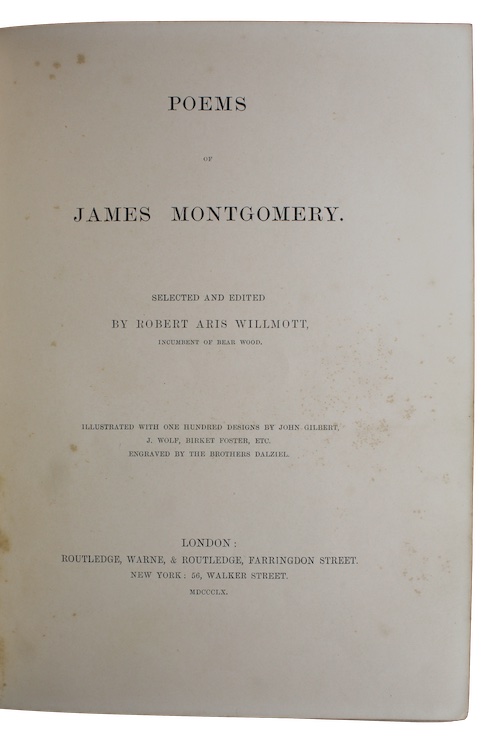
Poems.
London.
George Routledge, 1860.
Quarto.
[20], 379pp, [1]. With a portrait frontispiece and 99 illustrations in the text engraved by the Brothers Dalziel. Bound by Edmonds & Remnants in contemporary richly gilt-tooled green morocco, A.E.G., gilt dentelles. A trifle rubbed , marked, and bumped. Foxed, later inked ownership inscription of William Long to recto of FFEP, near contemporary gift inscription to front blank fly-leaf: 'Louisa Gould Long / with / Mary Tourner's love / & best wishes / Dec. 3rd 1863'.
A handsome copy of the collected poems of James Montgomery (1771- 1854), illustrated with one hundred wood engravings by, inter alia, Pickengill, Birket Foster, John Gilbert, and William Harvey, engraved by the Dalziel Brothers.
Fredrick Remnant, born 1780, was apprenticed to his bookbinder father between 1795 and 1807. He established his own premises by 1813, where he prospered, employing forty-five men by 1826. About 1824, at the suggestion of his foreman Jacob Edmonds, he began to produce bindings in embossed covers (a method popular in France). The pair went into partnership about 1829. The firm continued successfully, becoming one of the foremost binderies in England, until 1873 when it was taken over by Simpson and Renshaw. According to Ramsden, Arnett's Bibliopegia (1835, p.126) suggests Edmonds & Remnants originated arabesque binding by whole plates, which was later used widely for albums.
Fredrick Remnant, born 1780, was apprenticed to his bookbinder father between 1795 and 1807. He established his own premises by 1813, where he prospered, employing forty-five men by 1826. About 1824, at the suggestion of his foreman Jacob Edmonds, he began to produce bindings in embossed covers (a method popular in France). The pair went into partnership about 1829. The firm continued successfully, becoming one of the foremost binderies in England, until 1873 when it was taken over by Simpson and Renshaw. According to Ramsden, Arnett's Bibliopegia (1835, p.126) suggests Edmonds & Remnants originated arabesque binding by whole plates, which was later used widely for albums.
Ramsden p.121.
£ 200.00
Antiquates Ref: 20395